


.svg)
Why Under-the-House Breaks Are a Different Problem
When a sewer line breaks under your house or slab, the damage plays out underground, hidden beneath concrete or inside a crawl space. Instead of backing up into your fixtures, water leaks directly into the soil beneath your foundation.
By the time a drain acts up, the ground under your house has often already been shifting for weeks.
That's what makes a sewer line broken under your house a different problem entirely. You're not looking for a backed-up toilet or a slow drain. You're looking for:
- Cracks that weren't there last year
- A patch of floor that won't dry out
- A strip of ground along your foundation that stays soft through summer
In Greater Seattle, where wet winters keep ground moisture consistently high and most pre-1980 homes are still sitting on original under-slab pipe, these breaks tend to escalate well before homeowners realize what they're dealing with. Knowing what to look for is the difference between catching it early and finding out after the foundation has already moved.
And if you've already noticed some of the common sewer warning signs, what's happening under your house is worth a closer look on its own.

Is Your Sewer Line Broken Under the House? Watch for These Signs
These aren't the usual sewer symptoms. They're the ones that surface when the problem is directly below you, and they're easy to misread if you don't know what you're looking at.
1. Sewage Smell Rising From Your Floors, Not From the Yard
There's a specific difference between a sewer smell outside and one that comes up from inside your home.
When the break is under the slab or crawl space, the odor rises from a floor drain, a slab crack, or a crawl space vent. It sits low to the ground. It's strongest near the floor and doesn't clear with ventilation or cleaning products.
Homeowners almost always blame something else first:
- A dry trap
- A dirty drain
- Poor ventilation under the house
The tell is that it keeps coming back to the same spot, at the same height, regardless of what you do to the drains above it.
Seattle homes with crawl spaces are particularly prone to this pattern. The crawl space traps and concentrates the odor. In homes across Burien, Shoreline, and older parts of South Seattle, this is often the first sign a homeowner notices, sometimes months before anything else shows up.
2. Foundation Cracks or Floor Gaps That Showed Up Without a Clear Cause
This is the most under-house-specific sign on the list, and the one that gets dismissed the longest because it looks like normal settling.
When a broken sewer pipe under the slab leaks continuously, it saturates and erodes the soil beneath the concrete. The foundation loses support unevenly. Cracks appear:
- Along the slab
- At the base of interior walls
- Around door and window frames
- As visible gaps between the floor and baseboard
Seattle's clay-heavy glacial soils make this significantly worse. Clay expands when it absorbs water and contracts as it dries. A sewer line leaking into clay soil creates an ongoing cycle of movement, and over months, that movement becomes visible in the structure above it.
This is one of the signs of broken sewer line under house that gets misattributed to normal foundation settling the longest. If you're noticing new cracks and there hasn't been a major seismic event or an extended drought, the line under your slab is worth ruling out.
3. Damp or Warm Spots on a Concrete Floor With No Obvious Explanation
A section of the garage slab, basement floor, or utility room feels consistently damp or slightly warm. No appliance nearby. No pipe overhead. No water source explains it.
When a broken drain pipe under slab is close enough to the surface, moisture conducts through the concrete. It's not a puddle. It's a patch that never fully dries, sometimes with a faint odor, sometimes without.
Most homeowners write it off as condensation for months. The reason this matters: the longer that patch stays wet, the more soil has been displaced beneath it. What starts as a minor leak eventually creates a void. And voids under a concrete slab, left long enough, are why a floor cracks across an entire room instead of a single hairline fracture.
4. Soft or Sunken Ground Hugging the Base of Your House
Most guides on sewer leaks point to lush grass or soggy patches in the middle of the yard. That's a different problem.
When the break is under the house, the saturation shows up at the perimeter. Look for:
- A soft strip running along the foundation edge
- A small depression near a downspout that never dries between rain events
- Ground that gives slightly underfoot right where the exterior wall meets the grade
- A minor sinkhole forming along the foundation line
This pattern follows the footprint of the house because that's where the pipe is.
In Greater Seattle's wet climate, it can be hard to distinguish from general drainage issues in fall and winter. But if it's still there in July and August, concentrated along the house rather than a low point in the yard, it's worth having the line checked.
5. Pest Activity That Keeps Coming Back After Treatment
A broken sewer pipe under the house opens a direct route from the municipal sewer system into the space directly below your living area. Rats can squeeze through a gap about the size of a quarter. Cockroaches need even less.
They come up through:
- Floor drains
- Cracks in the slab
- Gaps around pipes
- Crawl space vents
The pattern that points to a sewer issue is specific: an exterminator treats the home, the problem improves briefly, then returns within weeks. No clear exterior entry point gets identified. The activity is concentrated near ground-level areas like basements, utility rooms, and crawl space access points.
If that's the cycle you're stuck in, the sewer line under the house is a logical next step before scheduling another treatment. Closing the pest entry point doesn't work until the break that created it is repaired.
Sewer Line Broken Under House: Why Seattle Homes Face This More Than Most
This isn't a generic aging-pipe story. The specific combination of soil conditions, housing stock, and climate in Greater Seattle makes under-house sewer breaks more likely here, and more likely to go undetected longer.
Original pipe that's never been touched
Exterior sewer lines in Seattle neighborhoods get inspected and sometimes replaced. The section running directly under the house is often the last to get looked at, or never gets looked at at all.
In homes across Renton, Shoreline, Burien, West Seattle, and Bothell built before 1980, the under-slab portion is frequently still original clay pipe, while exterior lines may include Orangeburg or cast iron that have exceeded their intended lifespan. Clay joints crack and shift. Orangeburg, a wood pulp and coal tar pitch pipe common in homes built between the 1940s and early 1960s, softens over time and eventually collapses inward.
Clay soils that move with the seasons
The glacial till that much of Greater Seattle sits on is dense with clay. Every wet season puts lateral stress on pipe joints beneath the slab. Every dry summer creates minor contraction and settlement.
Over 40 or 50 years, that repeated movement loosens joints, opens cracks, and shifts pipe sections, most often in the under-house section where the pipe has the least stable bedding.
Crawl spaces that hide the problem
A large share of pre-1980 Greater Seattle homes were built over crawl spaces rather than on slab foundations. When the sewer line fails under a crawl space, there's no concrete to crack visibly and no floor to show moisture.
The soil saturates quietly. The odor builds in a space most people enter once a year at most. By the time the smell reaches the living area or the ground outside softens noticeably, a sewer pipe broken under the house has often been active for months.
Roots that don't stop at the yard
Greater Seattle's tree canopy is dense in most older neighborhoods. Mature cedars, big-leaf maples, and cottonwoods are common in pre-1970s areas of Ballard, West Seattle, Beacon Hill, and Shoreline. Their root systems follow moisture through soil and don't distinguish between a pipe joint in the backyard and one under the slab.
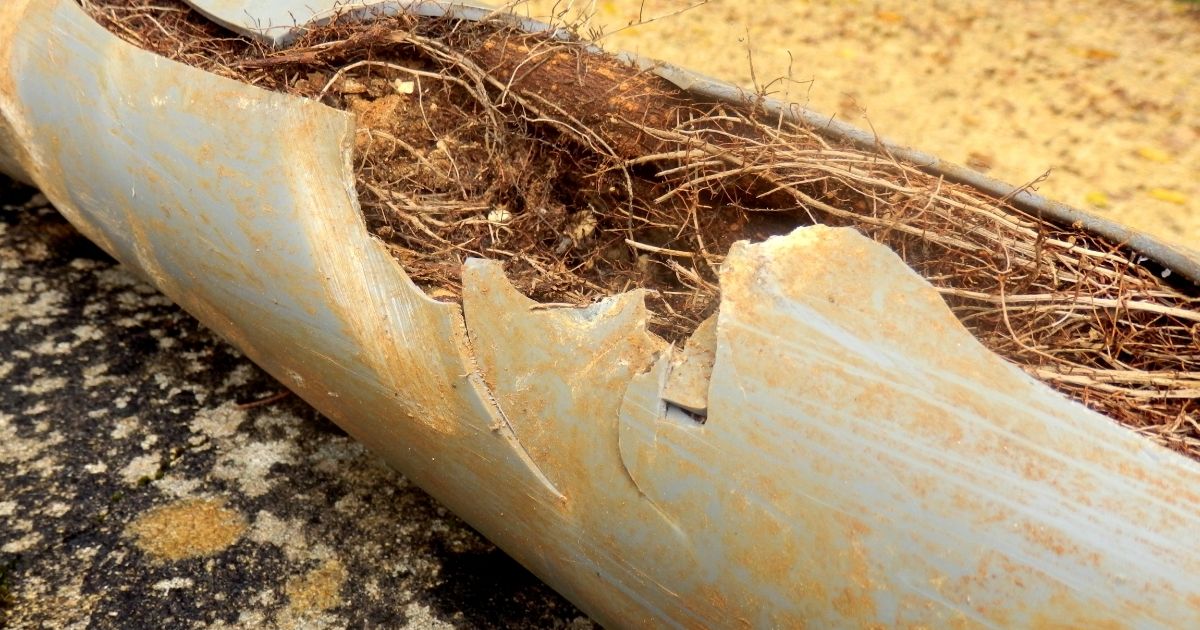
In homes where large trees sit close to the structure, root intrusion under the house is one of the more frequent findings during camera inspection, and one of the harder problems to catch without one.

What to Do When You're Seeing These Signs
When the suspected break is under your house, the standard first responses don't apply.
Snaking the drain clears debris at the fixture level but won't locate a break point under a slab. Chemical cleaners don't reach the under-house section. Running water repeatedly to test the drain adds pressure to a pipe that may already be fractured.
A few things that actually help before you make the call:
- Write down which signs you're seeing and how long each has been present. A contractor can use that timeline to narrow down the likely location before the camera goes in.
- Identify where the smell, moisture, or ground movement is concentrated. Which room, which wall, which side of the house. That information helps localize the inspection.
- Avoid back-to-back heavy water loads like laundry, dishwasher, and multiple showers running close together until the line has been checked.
- Check whether your sewer cleanout is accessible. It's typically a capped white or black PVC pipe near the foundation, in the basement, or in a utility area. A contractor needs access to it to run a camera through the main line.
The goal at this stage is to locate the break point, not just address symptoms at the surface. A sewer camera inspection is what confirms exactly where the line failed and how severe the damage is before any repair decisions get made.
If You're Seeing More Than One of These Signs, Don't Wait
Under-house sewer breaks are easy to explain away one sign at a time.
The smell gets blamed on the crawl space. The floor crack looks like normal settling. The soft ground along the foundation seems like a leftover drainage issue from a wet winter. Each one, on its own, is easy to postpone.
But these signs don't usually show up alone. The pattern they form together, odor from below, structural cracking, soil movement at the foundation edge, pests coming up from underneath, points to one place.
And the longer it stays unaddressed, the more the problem shifts from a sewer repair to a foundation repair. The sewer line is the part that can be fixed cleanly — in many cases through trenchless sewer repair that avoids breaking up your slab or excavating under the foundation. What happens to the soil and structure around it after months of continuous leaking is what gets expensive.
If any of the signs of broken sewer line under house described here sound familiar, the team at Aces Four has been diagnosing and repairing these exact problems across Greater Seattle. Reach out today for a free estimate and find out what's happening under your house before it turns into something bigger.
FAQs
Can a broken sewer line under the house damage my foundation?
Yes, and it's often the most costly consequence of a delayed repair. When the pipe leaks continuously under the slab, it erodes the soil supporting the concrete. That leads to foundation settlement, floor and wall cracking, and in serious cases, voids forming directly beneath the structure. The longer it goes undetected, the more the repair scope expands beyond the sewer line itself.
How is a sewer line broken under the house different from a regular sewer problem?
A standard sewer problem affects how your drains perform. A break under the house also affects your structure. You may see foundation cracks, damp concrete, or soil movement along the foundation perimeter before any drain shows a problem at all.
What does sewage smell from inside the house indicate?
When the odor rises from a floor drain, slab crack, or crawl space vent and sits low in the room, it usually points to a break close to or directly under the living space. It doesn't clear with cleaning, which is what separates it from a dry trap or a general ventilation issue.
How do I know if soggy ground near my foundation is a sewer issue?
Location is the key indicator. If the wet area runs along the base of the house rather than following a yard drainage slope, and it stays damp between rain events well into summer, it may be soil saturation from a sewer line leaking under the slab.
Are older Seattle homes more at risk for under-house sewer breaks?
Significantly. Homes built before 1980 in Greater Seattle often have original clay pipe under the slab, and those from the 1940s to early 1960s may have Orangeburg on the exterior line as well. Neither has likely been inspected. Add Seattle's clay soils, wet winters, and mature trees near the foundation, and the conditions for under-house pipe failure are well established.
Can tree roots break a sewer line that runs under the house?
Yes. Roots follow moisture through soil and enter pipe joints wherever they find a gap, including under the slab. In pre-1970s Greater Seattle homes with large trees close to the structure, root intrusion under the house is a frequent finding during camera inspection and one of the more common causes of under-house sewer failure.

.svg%20fill.svg)



.svg)
.svg)

.svg)



.svg)