A sewer cleanout is the capped pipe that lets a technician reach your sewer line straight from the yard. Without one, clearing a clog means pulling a toilet or working down a roof vent, which turns a simple job into a bigger, messier one. If your Seattle home was built before cleanouts were standard, or someone paved over the one you had, a sewer cleanout is the fix that makes every visit after it faster and cheaper.
Aces Four has installed and repaired cleanouts across Seattle since 1978. We are family-owned, licensed, insured, and bonded, and as a drainage and sewer contractor, exterior cleanout work on the line is squarely our trade. We run our own excavation crew instead of handing your yard to a subcontractor, so one team finds the line, sets the fitting, pulls any permit the job needs, and puts the ground back.
No Hatch, No Easy Fix
Reasons Homeowners Finally Add One
Most people never think about a cleanout until a backup forces the issue. These are the situations that bring the call:
✓No Cleanout Anywhere on the Property
A plumber has to reach the line through the house itself. Every clog becomes a bigger job than it should be.
✓The Cleanout Is Buried
Landscaping, a patio, or a concrete pour covered it. It exists, but no one can reach it when the line backs up.
✓The Cap Is Broken or Cemented Shut
A cracked or stuck cap lets in dirt and roots and defeats the access. A fresh cap restores a clean, sealed entry.
✓A Backup Keeps Returning
If the line clogs on a schedule, an accessible cleanout makes each clearing quicker and gives us a camera port to find the cause.
✓The Riser Sits Below Grade
A cleanout that ends underground fills with mud and standing water. Raising it to the surface keeps it dry and usable.
✓The City or an Inspection Requires One
Some code requirements and permit conditions call for an accessible cleanout. Adding one keeps the property compliant.
✓A Home Sale Flagged It
Inspectors and buyers note a missing or buried cleanout. Installing one clears the report before it stalls a closing.
Backed up right now and no way to reach the line? Our emergency sewer service can add an accessible cleanout as part of clearing the line, after hours or on a weekend when it can't wait.
Not sure whether you already have one? We locate the line first and confirm whether a cleanout exists before we scope the work.
Half the work is knowing where the sewer runs before anyone digs. Guess wrong and you get a bigger hole and a bigger bill, so we find the line first, then choose where it goes.
Site walk and camera. We start with a visual search, then send a camera down the line and track the sonde from the surface to trace the exact path.
Electronic locating and depth marking. A locator maps the pipe across the yard with no trial holes, and we flag how deep it sits so we know the dig size and riser length up front.
City records check. Where they exist, we pull side-sewer records and as-builts to establish line direction and slope before we commit.
811 utility locate. Before any excavation we call in the public locate so gas, power, and water lines are marked and avoided.
Written summary with photos. You get a record of what we found and where, not just a verbal rundown.
Once the line is mapped, we confirm the plan and show you the spot before we open the ground. For a full look inside the pipe, our sewer camera inspection uses the same gear to check condition and slope.
From Locate to Clean Lid
What a Sewer Cleanout Install Covers
A sewer cleanout installation is a single focused job, and many run start to finish in a day. Here is the shape of it:
Locate and mark the line, agree the placement with you, clear the 811 locate.
Excavate a narrow access hole down to the pipe, hand-digging near marked utilities and roots.
Cut into the line, fit the cleanout tee, and set the riser to grade.
Add the box, cap, and lid, plus a backwater valve if you want one.
Run a flow test and a camera check to confirm it seats and drains.
Backfill, compact, restore the surface, then show you how to open and use it.
What stretches a job is the locating, not the fitting. If the line sits deep or hides, finding it takes the time. Financing is available through GreenSky if you would rather spread the cost.
One Access Point or Two
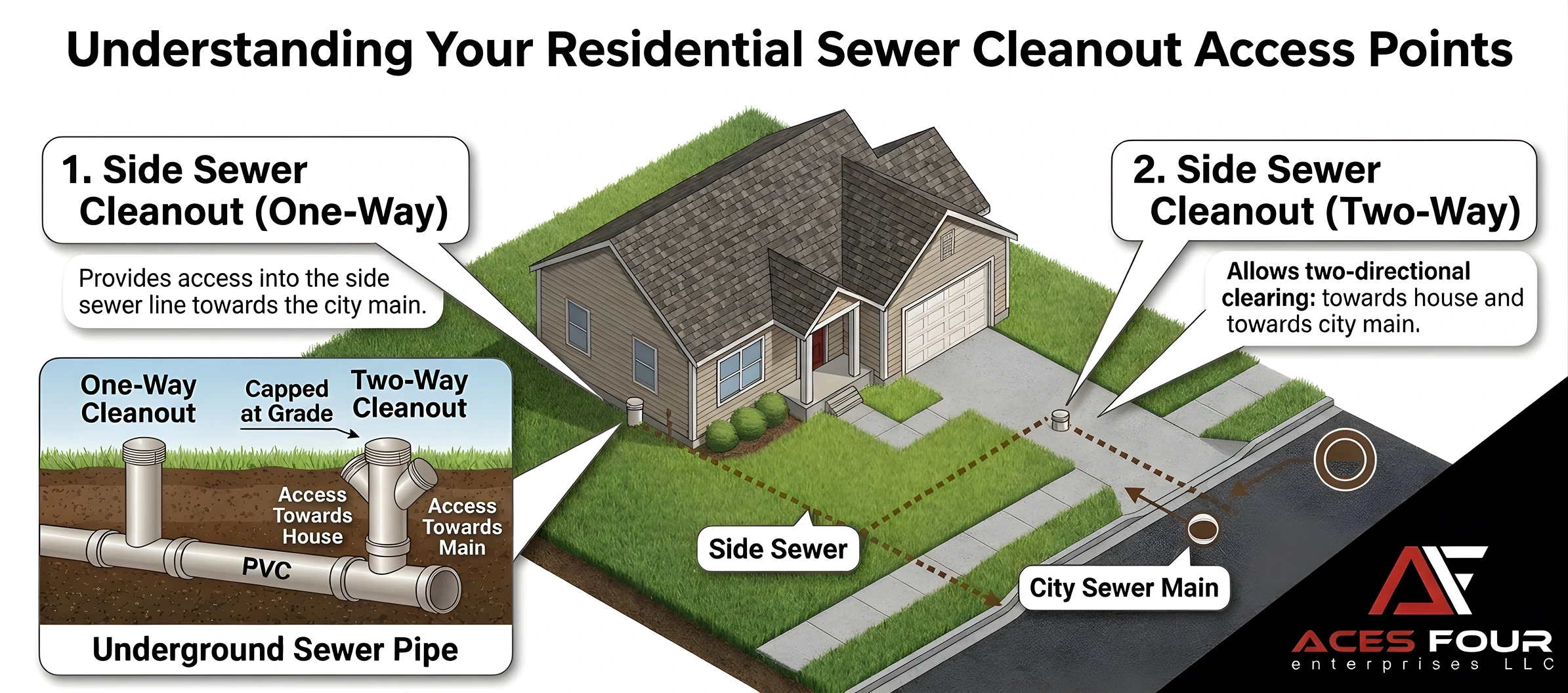
Cleanouts come in a few configurations, and the right one depends on your line and how you expect to use it:
One-way reaches the line from a single direction. Simple and low-profile, common on short runs.
Two-way opens both directions from one spot, toward the house and toward the main. A two-way cleanout near the property line is common on longer runs, and many local jurisdictions want one point near the building and another out toward the city main.
At-grade with box and lid finishes flush with the lawn or driveway and takes foot or vehicle traffic.
With a backwater valve lets waste out and blocks it from flowing back in, for properties prone to main-line backups.
We tell you the least you can install and still solve the problem, not the most we can sell.
Fixing a Cleanout That Stopped Working
Not every call is a new install. Plenty are cleanouts that used to work and quit. Sewer cleanout repair covers the common failures:
A broken sewer cleanout cap. Cracked, missing, or cemented shut, it lets in grit and roots. We fit one that seals and opens cleanly.
A crushed or offset riser. Soil movement or a passing vehicle can collapse the riser above the line. We dig it out and replace the damaged section.
A cleanout lost under new surface. Landscaping or a concrete pour swallowed it. We locate it, expose it, and raise it back to grade so it is usable again.
If the pipe itself is failing rather than the fitting, that is a different job, covered on our sewer pipe replacement page.
The Crew and Gear That Show Up
A cleanout is small compared to a full dig, but it still takes the right equipment to do it clean and safe:
Mini-excavator for a tight, controlled access hole, with hand-digging near marked utilities and roots.
Concrete saw and core drill for cutting through a driveway, slab, or patio over the line.
Camera, sonde, and locator to map the line going in and verify the fitting going out.
Compaction and pipe-fitting tools to backfill solid and seat the connection right.
We run the core of every job in-house, so the crew that locates your line is the one that fits the cleanout and restores the ground. Every dig starts with a utility locate, and we contain and haul off the spoils rather than leaving a pile behind.
Permits and Inspections, Handled
Some cleanout jobs need a permit and a city inspection, and the rules shift from one jurisdiction to the next across the Seattle area. We handle that side end to end:
The permit application where the work requires one.
811 utility locates before we dig.
Right-of-way or street-opening permits if the access point falls near the roadway.
Scheduling the city inspection and meeting the inspector on site.
You get a clean, compliant cleanout and the paperwork to prove it, without spending your week on the phone with a permit office.
A Cleanout Is Only Good If It's Done Right
What You Get With Our Crew
Cleanout work looks simple until the line is deeper or further off than expected. What you get with Aces Four is a crew that plans for that before the first cut.
One Seattle-area homeowner called us to install a cleanout on an older home, and we found and repaired a root-blocked connection to the city line in the process, permitted and inspected.
We locate before we dig
The worst job is one that tears up a yard because no one found the line first. We trace and mark the pipe, then dig one small opening in the right place.
One in-house crew, front to back
The people who find your line fit the cleanout and fill the hole. Nothing is lost in a handoff to a subcontractor.
Small hole, full restoration
We dig only what the access point needs and put the surface back, lawn, gravel, or concrete. No scar left for you to fix.
We stand behind the work
If something isn't right with the cleanout we installed, we come back and fix it. No claim forms, no third party, the same crew that did the work handles it.
A sewer cleanout is a cheap upgrade that lowers the cost of every service call after it. Aces Four locates the line, installs or repairs the access point, and restores your yard, one family-owned crew working Seattle sewers since 1978.